Forty Pomeranian families, under the leadership of Heinrich von Rohr, journeyed to what would become southeast Wisconsin as pioneers, in the hopes that Grabau and the rest of the emigrants would follow. This hope was not fulfilled, as Grabau and the others — about three-fourths of the emigrants — remained in and around Buffalo.
But these Lutherans were the first large, unified company to arrive in Wisconsin for the expressed purpose of remaining and forming a settlement together. When they arrived in Milwaukee under von Rohr’s leadership, they immediately received a number of offers near the city, which had about 5,600 residents at that time. But they preferred to go deeper into the primitive forest, where they could buy government land not only for themselves but also for the brethren still to follow.
Since it was already late in the year, the Lutherans considered it necessary to decide quickly where they would settle. They charged von Rohr, August Radue and Martin Schoessow with looking for suitable land. A mill owner named Turk proved especially helpful to the new Wisconsinites in their search. With his help, they looked at a number of sites. This was not so simple at that time, since the forest was so thick and dark that one had to travel through it with a compass, as if at sea. One often could not see the sky through the thick foliage of the enormous oaks, maples and walnut trees.
Finally, they found a site along a delightful stream, 16 miles northwest of Milwaukee in Washington County, which later became Ozaukee County. They decided for this spot and later gave it the name Freistadt. They bought 1,200 acres at first from the Land Office and must have soon bought more to provide each settler with the 40 acres planned, plus 40 acres in the middle of the settlement as church property. Everyone who bought land, including those who came later, was required to contribute one shilling per acre for the purpose of establishing church and school and support the preacher. After registering with the Land Office, von Rohr was busy for several weeks surveying the land, during which time they camped in tents, which they had brought along.
Then each was issued his plot and the title to the land in an order chosen by lottery. The church property was provisionally put under the names of von Rohr and the parish council member Lucke. It was located in Town IX, Section XIX, Range XXI East and stretched from von Rohr’s farm to the properties of M. Schoessow and C. Knuth, the blacksmith.
Once this was settled, the families began to move out of Milwaukee. About 20 families did remain in the city, above all fishermen and artisans, who laid the groundwork for a congregation there and soon began worship services in a rented hall.
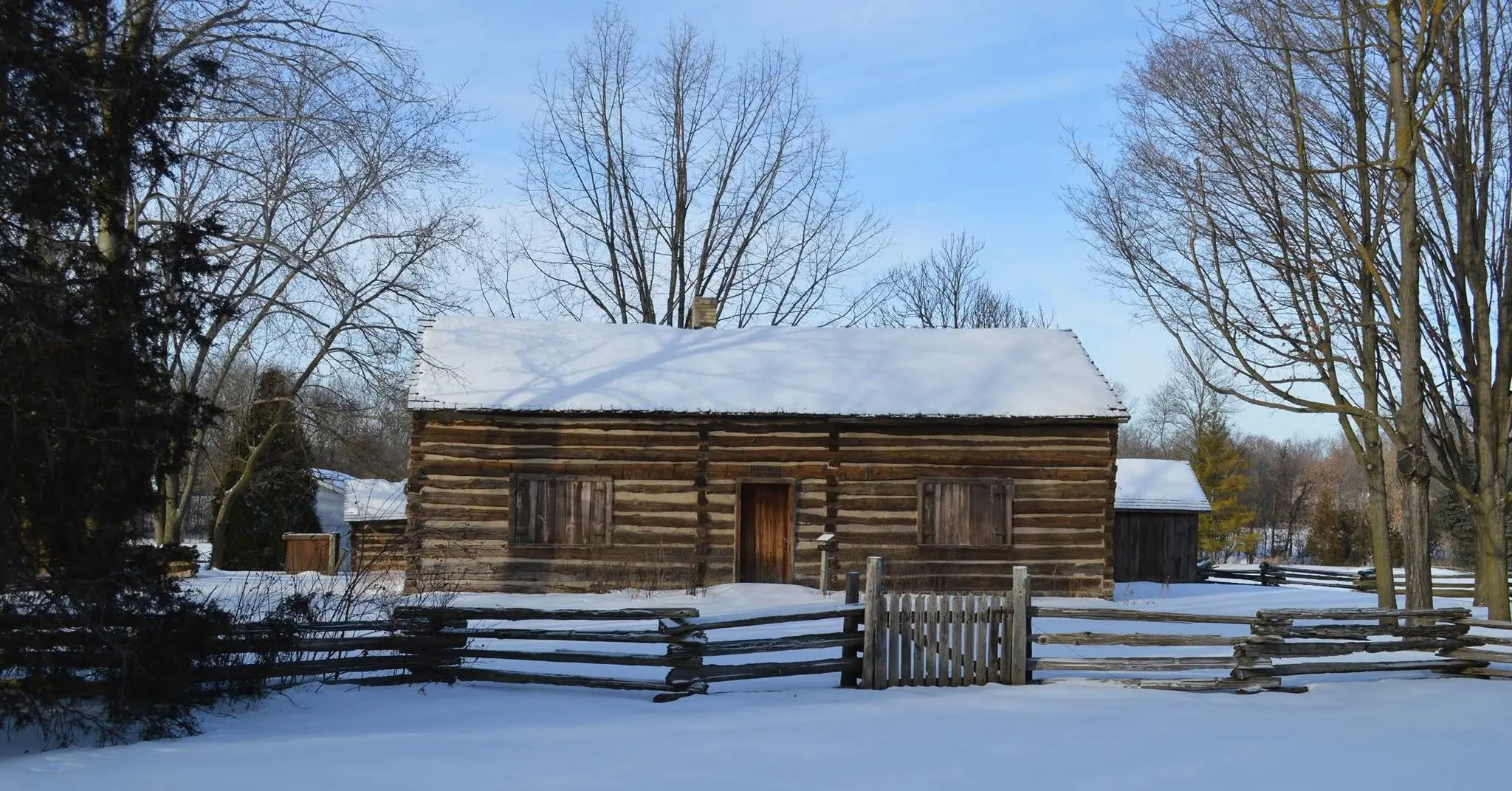
The colonists, on the other hand, immediately set about building their log houses, assisted by Turk and several other Americans from the area. By late October, the first ones were finished, and when the severe winter of 1839–40 began in November, almost all of the settlers were safely under cover. Several families were caught off guard and were living in brush huts when the first snowfall came. But they also managed to finish construction before the winter fully set in.
When von Rohr moved in on November 14, he was said to possess only one dollar and a little food. He had sacrificed all his property, including the maternal inheritance of his four-year-old daughter, Julia, to the congregation. His loyal aide, a former officer named Guttner, who had watched over his antique bookstore in Magdeburg while von Rohr was in prison or on journeys, also lived with him.
The colonists immediately began clearing and fencing in their property. This required felling the mighty trees — often three to four feet across — some of which were then sawed into logs and split for use as support beams. Much wood was burned as well. They could not accomplish in a week with their bare hands what a pair of oxen did in one day. But there was only one yoke of oxen. Thus it was a great gain for the colony when the Silesian Hegwer joined them from Illinois with a second yoke.
All this time food was scarce. They had bread and black coffee, and twice a week bacon or salt pork. The few draught animals they had were not enough to bring them the most basic food supplies through ten miles of forest without a road and six miles of bad road from Milwaukee the whole winter long. As a result, the fathers often had to carry food on their backs, wading through or crossing on fallen trees some 30 streams.
Heinrich von Rohr even did this for the Christmas festival in 1839, according to a biography in a congregational calendar for Milwaukee in 1909. He had to carry 80 pounds of flour and other supplies by himself to keep from going hungry at Christmas. In addition, he, like many others who had no money, had to sell all sorts of valuable items, or even clothing. Many also had to buy everything on credit. And still, we hear that all were happy around the Christmas tree, and the first Lutheran hymns of the Savior’s birth sounded in the forests of Wisconsin. They had to endure a difficult time, and the winter lasted long. The snow remained three to four feet deep until early May, and Indians passed between the log houses on snowshoes, hunting deer. The first pioneers met with the Indians often. But the latter were friendly, since the last hostile Indians had been eradicated from the state in the Black Hawk war of 1832. The colonists were also fortunate that they followed Thompson’s advice again by bringing along a large supply of American axes, saws and drills.
Once the sap finally began to rise in the trees, the colonists enjoyed an elegant addition to their fare. They drilled into the sugar maples, collected the sap and cooked it into syrup. Von Rohr alone made 100 wooden troughs for collecting the sap. And before the vegetables grew, the land itself yielded nettles and all kinds of leaves and forest vegetation. By June all the vegetables and grain stood tall on the six acres of cleared land.
In the spring of 1840, the settlers erected a special structure for church and school — 30 feet long and 20 feet wide. Since they did all the labor themselves, the building cost only $45.00. Eventually this church was named “Trinity.” This was to be the first of four structures the congregation built. The fourth church, designed by Architect Frederich Velguth, was built in 1884 and is still in use today, on the same land that was purchased in 1839.