The Emigration Story · Part II of V
The Old Lutherans' Attempts to Leave Prussia
Leaving Pomerania in 1839
Abstract: Already in 1837, King Friedrich Wilhelm of Prussia agreed that the confessional Old Lutherans should be allowed to leave Prussia, since they obviously would never agree to join the new Union Church anyway. Unfortunately, making that decision and doing it were two different things. When the applications to leave the country for religious reasons started pouring in, the King simply could not get himself to issue those permits.
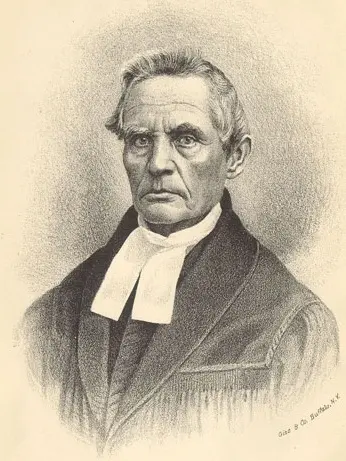
As a delaying tactic, the King decided that none could leave unless they were under the care of a Lutheran pastor. Since not many Lutheran pastors were in a position to leave the country, this delayed the emigration for more than a year. Rev. Kavel did leave with a group in 1838 that went to Australia, and Rev. Krause agreed to take a group from the province of Silesia to America. Rev. Grabau also agreed to take a group from the provinces of Pomerania, Brandenburg and Saxony to America, but this group encountered many delays.
The rule that the emigrants must go with a clergyman applied only to those who said on their application that they were leaving because of their Lutheran faith. Those who said they were leaving for financial or other reasons could leave as they wished. The result was that those who wanted to leave in 1840, 1841 or 1842, when there was no pastor leaving, had no choice but to list some other reason for leaving if they wanted to get a permit. However, when they got to Buffalo or Milwaukee, they immediately joined the other Old Lutherans in their congregations.
The first delay that the Pomeranian Lutherans encountered was that both von Rohr and Rev. Grabau were in prison in early 1839. Grabau was released on April 23 and von Rohr on May 13. Besides that, the local officials in Pomerania were strongly anti-Lutheran and delayed handing out the permits.
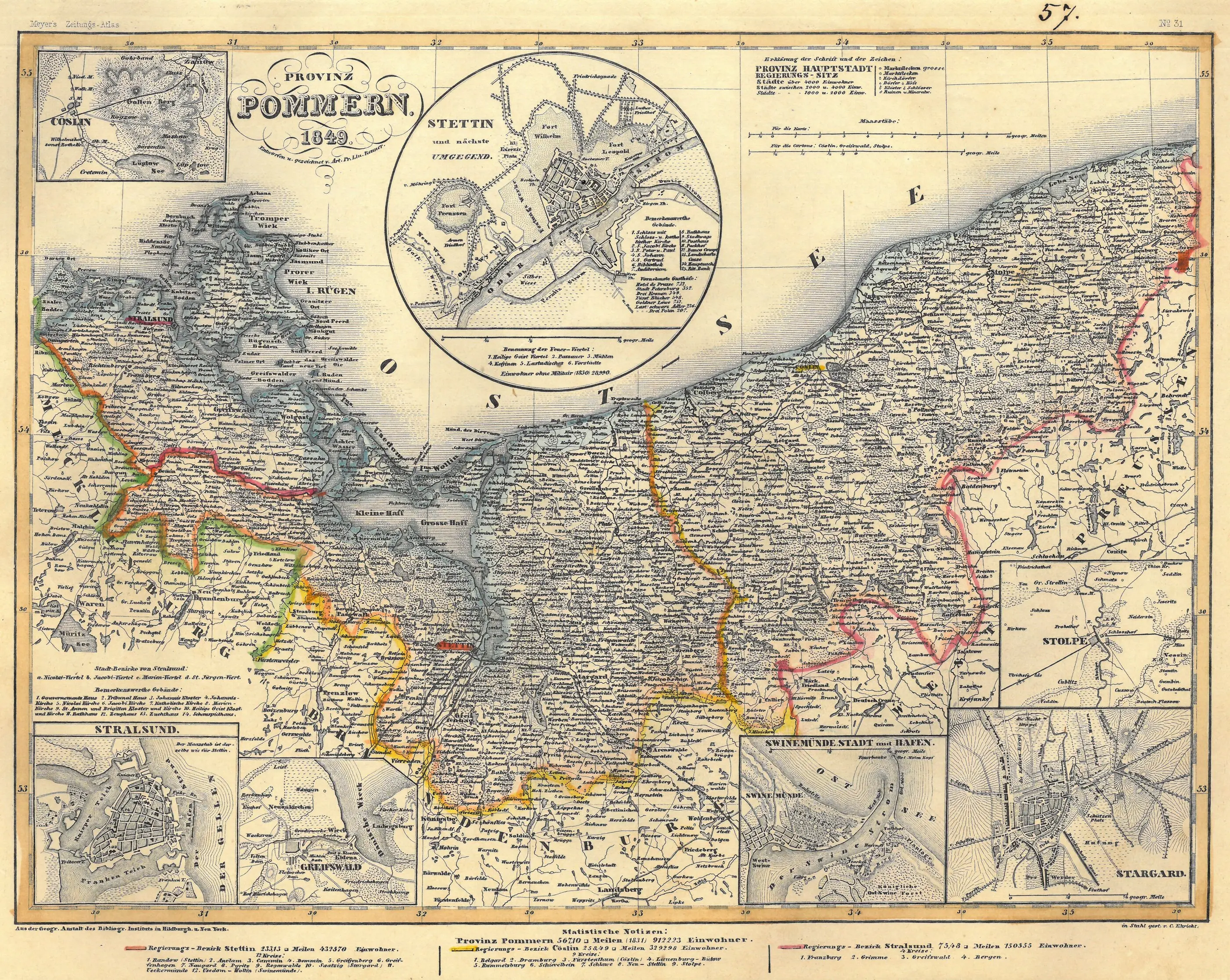
The Lutherans in the Regenwalde and Greifenberg area decided not to wait, and they assembled in Plathe on May 16, about 176 strong. They camped in stables for two days and then they went to the provincial capitol of Stettin, arriving there in May with their horses and wagons. Most likely in this group were the four Klug families and the Knuths, Radues, Halls, and Schenzels. By May 31, they had their permits, and they started on their way by horse and wagon to Hamburg to wait for the ships.
In the Cammin and Wollin areas the government official, von Voeltz, was particularly difficult, and those Lutherans did not all get their permits until June 22. Police were posted on the roads out of town to make sure they did not leave without permits. Part of the group took horses and wagons to Stettin and then Hamburg, and part of the group took boats to Stettin and then canal barges to Hamburg. As the boats pulled away from the docks in Cammin, the Lutherans sang the hymn, “Help, Dear God”. There were over 300 people in these groups, and they probably included the families Bruss, Pipkorn, Helm, Tews, Bellin, Wilde and Schoessow.
Some had special problems. John Pritzlaff from Triglaff never did get his permit, so he left without it. The Hilgendorfs from Dresow were trying to get one of their six boys out of the army, and they were among the last to get their permits. Grabau had gone to Hamburg and was meeting the emigrants as they arrived.
The detailed story: As late as January 1839, the Lutherans were still sending requests to their king, asking that he permit Lutheran churches in Prussia. When the king refused to consider these requests, preparations for emigrating to America proceeded in earnest. The situation was complicated by the fact that both Rev. Grabau and Heinrich von Rohr were still in prison in April.
In January of 1839, the emigrants faced one huge obstacle, which even threatened to cancel the entire emigration of 1839. Not only was the only clergyman whom they considered as their pastor sitting in prison in Thuringia, but he also became seriously ill. Requests were sent to the authorities, and even a petition sent to the king, by the congregations of Erfurt and Magdeburg, which were preparing for the emigration, and by Grabau’s wife. They asked that Grabau be released from prison and placed in a private house to be given better care.
Even the governor of the province, Count Stolberg of Wernigerode, showed concern by suggesting that Grabau could die. This, he claimed, would not only have been a difficult blow for the large number of emigrants, whose emigration would have been postponed until they had found another pastor, it would also have been an unpleasant matter for the authorities and even the king. He argued that the people would have used the incident against the government by creating a martyrdom, which would provide a large boost not only for the emigration, but also for the entire separatist movement.
Fearing this, the government gave in to the requests and had Grabau released from prison and transferred to a private house under police surveillance. Grabau recovered quickly there, and in April of 1839 the doctor declared that he would be able to travel in June.
For our detailed account of the emigration, we begin with the region of Erfurt, for which we have the best resources, particularly from the consistorial archives. On January 24, 1839, 28 heads of family, most of them from Erfurt itself, had sent a request for permission to emigrate to the magistrate. In this request the religious motive is again unambiguously present. It read:
The undersigned Evangelical-Lutheran residents of this city have seen, after having tolerated eight years of persecution of the Evangelical-Lutheran Church in Prussia by the United State Church, that no more hope exists that the Evangelical-Lutheran Church will be granted the right to independent, separate church services and other rights. We are in danger of being led into persuasion and force by the United State Church, because we lack the holy orders and with that the spiritual care and the sacraments, which we need in order to resist the powerful illusions of these recent, troubled times. Thus we have resolved to seek another country where we have the protection of the authorities to practice our free and separate Evangelical-Lutheran worship service. We obediently beg the highly esteemed magistrate to bring about most graciously the granting of permits by the royal government for emigration …
Grabau had received his permit while still in prison in Heiligenstadt on April 21 and left Magdeburg by steamboat on June 13.
In the meantime, von Rohr was continuing to actively promote the emigration. It should not go unmentioned here that the highest levels of government were still trying to dissuade the organizer of the emigration and thus to cripple the entire movement at the last minute. The crown prince showed great sympathy for the Lutherans and had already taken up relations with Pastor Kavel in 1835. In early 1839, he sent his aide-de-camp to von Rohr (a former officer in the Kaiser Alexander Guard Grenadier Regiment) in Magdeburg with instructions to wait with the emigration, promising to tolerate the Lutherans and guarantee free practice of religion as soon as he came into office.
That was certainly both a great honor and a great temptation for von Rohr. He resisted, however, saying that they could not wait for the king to die, and that the Lutherans considered it their duty to flee from the persecution by the United Church and from spiritual starvation, in order to save their souls and that of their children. (It is well known that the crown prince often had heated arguments with Altenstein and with his father about the treatment of the Lutherans.)
It hindered the organization of the emigration little that von Rohr was arrested and in the end sentenced to prison. Here it will suffice to say that he still had enough freedom while he served his sentence to continue recruiting for the emigration movement. During his imprisonment in Magdeburg (March to May 1839), von Rohr made decisive preparations for the voyage to America.
On his first visit to Bremen and Hamburg in 1838, he had been able to find no better conditions for travel than those offered by Sloman. But this was for 40 talers (thalers) per person, on the average, for the direct trip from Hamburg to New York. This worried the deputies greatly, because they barely had gathered 30,000 talers for 1,000 passengers.
Then two young merchants from Hamburg, John Frantzel and Batke, came to Magdeburg to see him in prison and presented to him a plan, by which the congregation would travel by steamship from Hamburg to Hull, from Hull to Liverpool by canal boat through England and from there to New York on returning American ships for about 29.50 talers per person. Von Rohr himself would function as the principal agent to save the one to two taler agent’s fee.
Frantzel and Batke themselves would settle for one taler per person plus expenses in anticipation of future business. This was such a good offer that von Rohr devoted himself entirely to getting his prison term commuted. He succeeded in doing this, at least by a few days. On the day he was released, May 10, he requested and received a passport for a trip to Berlin, Stettin and Hamburg. On May 13 we find him in Kammin, Pomerania, where the majority of the Lutheran emigrants of 1839 came from.
(A thaler is regarded as being worth 69 U.S. cents.)